.webp)
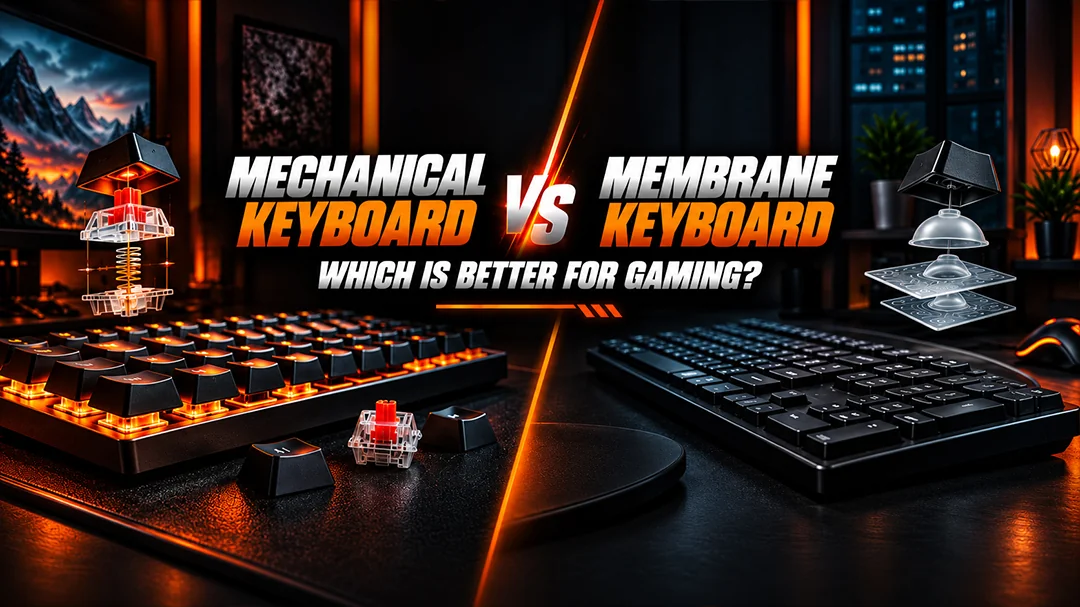
Choosing the right keyboard can make a noticeable difference to your gaming experience. Whether you play competitive FPS games, enjoy multiplayer adventures, or spend hours playing strategy titles, your keyboard affects how quickly and comfortably you interact with the game. However, with so many options available, one common question remains: mechanical keyboard vs membrane which one is better for gaming?
Both keyboard types have their own advantages. Mechanical keyboards are known for their individual switches, tactile feedback, and customization options, while membrane keyboards are often appreciated for their affordability, quieter operation, and straightforward design.
In this guide, we will compare both options in terms of responsiveness, durability, typing feel, noise, maintenance, and price. By the end, you will understand the difference between a mechanical keyboard and a membrane keyboard and which one best suits your gaming style and budget.
Table of Contents
- What Is a Mechanical Keyboard?
- What Is a Membrane Keyboard?
- Mechanical Keyboard vs Membrane: Key Differences
- Gaming Performance and Responsiveness
- Typing Feel and Comfort
- Durability and Long-Term Reliability
- Noise Levels: Which Keyboard Is Quieter?
- Price and Value for Money
- Which Keyboard Is Better for Different Types of Gamers?
- How to Choose the Right Keyboard for Your Setup
- Mechanical Keyboard vs Membrane – Conclusion
- Frequently Asked Questions
What Is a Mechanical Keyboard?
A mechanical keyboard uses individual mechanical switches beneath its keys. Each switch contains a mechanism that registers a keypress when activated. Depending on the switch type, you may experience a noticeable tactile bump, an audible click, or a smooth linear movement.
Mechanical keyboards are popular among gamers because they offer consistent feedback and a wide range of switch options. Players can choose switches based on their preferred typing feel and gaming requirements.
Key Features of Mechanical Keyboards
- Individual switches: Each key has its own mechanical switch mechanism.
- Distinct feedback: Switches can provide tactile, clicky, or linear feedback.
- Customization: Many models support keycap replacement, RGB lighting, and different switch options.
- Durability: Mechanical switches are often rated for tens of millions of actuations, depending on the model.
- Gaming features: Selected keyboards offer anti-ghosting, N-key rollover, programmable keys, and dedicated gaming modes.
For players who spend considerable time gaming, mechanical keyboards can offer a comfortable and consistent experience. However, the actual performance depends on the keyboard's switches, firmware, build quality, and connection type.
What Is a Membrane Keyboard?
A membrane keyboard uses pressure-sensitive membrane layers beneath the keys. When a key is pressed, the layers make contact and register the input. Unlike traditional mechanical keyboards, membrane models do not use an individual mechanical switch for every key.
These keyboards are widely used for everyday computing, office work, and casual gaming because they are generally affordable and easy to use.
Key Features of Membrane Keyboards
- Affordable pricing: Many membrane keyboards are available at budget-friendly prices.
- Quieter operation: They generally produce less keypress noise than clicky mechanical keyboards.
- Soft keypresses: Their keys often have a softer, less pronounced feel.
- Simple maintenance: Most standard models have a straightforward design, although cleaning still requires care.
- Practical everyday use: They can handle browsing, typing, studying, and casual gaming.
A membrane keyboard can be a sensible option for beginners who want a functional gaming setup without spending heavily on peripherals.
Mechanical Keyboard vs Membrane: Key Differences
When comparing a mechanical keyboard vs membrane keyboard, it is important to look beyond price. The right choice depends on your gaming habits, preferred typing feel, and the features you actually need.
| Feature | Mechanical Keyboard | Membrane Keyboard |
|---|---|---|
| Key mechanism | Individual mechanical switches | Membrane layers and pressure contacts |
| Typing feel | Varies by switch type; often more defined | Usually softer and less pronounced |
| Response | Depends on switch and keyboard design | Depends on membrane design and electronics |
| Durability | Often rated for tens of millions of actuations | Varies by construction and model |
| Noise | Can range from quiet to loud | Generally quieter |
| Customization | Often offers more options | Usually more limited |
| Price | Available across a wide price range | Often more affordable |
| Best suited for | Enthusiasts, frequent gamers, and customization | Budget-conscious users and casual gaming |
Neither design automatically guarantees better gaming performance. A well-designed membrane keyboard can work perfectly well for many games, while an entry-level mechanical keyboard may lack features found in more advanced models.
Gaming Performance and Responsiveness
Gaming performance is one of the biggest considerations when deciding between these keyboard types.
Mechanical Keyboard for Gaming
Mechanical wireless gaming keyboards can provide consistent actuation and a clearly defined keypress feel. This can be useful in games that require frequent movement inputs, rapid key combinations, or repeated actions.
For example, FPS players often use movement keys while simultaneously activating abilities, reloading, or switching equipment. A keyboard with reliable key registration and suitable rollover support can help manage these inputs. However, a mechanical switch alone does not guarantee lower input latency. Polling rate, firmware, USB connection, and the keyboard's internal processing also influence responsiveness.
Membrane Keyboard for Gaming
A membrane keyboard can also deliver reliable inputs for gaming. Modern membrane models may include anti-ghosting features, gaming modes, and layouts designed for frequent gameplay. The main difference is often the feel of the keys rather than a universal difference in speed. A good membrane keyboard can be suitable for casual games, adventure titles, racing games, and even competitive play when its input capabilities meet the player's needs.
Typing Feel and Comfort
Typing feel is another important factor in the mechanical keyboard vs membrane comparison, especially if you use your gaming keyboard for work or study.
Mechanical keyboards offer several switch styles. Linear switches move smoothly, tactile switches provide a noticeable bump, and clicky switches produce an audible click along with tactile feedback. This variety allows users to choose a typing experience that matches their preferences. Membrane keyboards typically offer a softer keypress, with less pronounced feedback. Some users find this comfortable, particularly when they prefer a simple keyboard for everyday use.
Comfort also depends on key spacing, keyboard height, wrist position, desk setup, and typing habits. Neither keyboard type is automatically better for every user.
Durability and Long-Term Reliability
Durability matters when your keyboard is used for extended gaming sessions.
Mechanical Keyboard Durability
Many mechanical switches are rated for tens of millions of keystrokes. Individual switch designs and replaceable keycaps can also make some models easier to maintain or customize.
However, switch ratings do not represent the lifespan of the entire keyboard. Electronic components, cables, stabilizers, and manufacturing quality also affect reliability.
Membrane Keyboard Durability
Membrane keyboards have fewer individual switch components and can offer dependable service when used appropriately. However, the membrane layers and contact mechanisms may wear with repeated use, depending on their construction and quality.
Spilled liquids, dust, excessive force, and poor maintenance can affect either keyboard type.
Noise Levels: Which Keyboard Is Quieter?
Noise is an important consideration if you game in a shared room or use a microphone during online matches.
Mechanical keyboards can be quiet or loud depending on their switches and construction. Clicky switches produce noticeable sounds, while linear switches are generally quieter. Dampening materials and keyboard design can also affect the sound.
Membrane keyboards usually produce less pronounced keypress noise, making them a practical choice for shared workspaces and quieter environments.
Keep in mind that no keyboard is completely silent during normal use, and some membrane models can still produce noticeable sounds.
Price and Value for Money
Budget is often the deciding factor when choosing between a mechanical keyboard and a membrane keyboard.
Membrane keyboards are commonly available at lower prices, making them suitable for first-time gamers or people building an affordable gaming setup.
Mechanical keyboards come in a broader range of prices. Entry-level models can be affordable, while premium models may offer hot-swappable switches, advanced lighting, compact layouts, dedicated software, and additional customization.
When comparing products, check the actual specifications rather than assuming that every mechanical keyboard is better than every membrane keyboard.
Consider your overall setup budget, the games you play, and whether features such as anti-ghosting, programmable keys, or customizable switches are important to you.
Which Keyboard Is Better for Different Types of Gamers?
The best choice depends on the games you play and your personal preferences.
FPS and Competitive Gaming
If you regularly play competitive shooters, look for reliable key registration, suitable rollover support, consistent actuation, and low input latency. A mechanical keyboard can be a strong option, but compare the actual specifications rather than choosing based on switch type alone.
Casual and Story-Based Gaming
For casual gaming, role-playing games, and story-driven adventures, either keyboard type can work well. A membrane keyboard may offer everything you need without requiring a larger investment.
MMO and Strategy Games
Players who frequently use complex key combinations may appreciate a mechanical keyboard with suitable rollover support, programmable keys, or additional macro functionality. However, these features are model-specific and are not exclusive to mechanical keyboards.
Gaming and Everyday Productivity
If you use one keyboard for gaming, office tasks, and studying, consider typing comfort, noise levels, layout, and ergonomics alongside gaming performance.
How to Choose the Right Keyboard for Your Setup
Before purchasing a keyboard, consider the following factors:
- Set your budget: Decide how much you want to spend before comparing models.
- Identify your gaming style: Determine whether you need frequent simultaneous key inputs, programmable functions, or simply reliable controls.
- Check switch characteristics: For mechanical keyboards, compare linear, tactile, and clicky switches.
- Review technical specifications: Look for anti-ghosting, rollover support, connection type, and polling rate where relevant.
- Consider noise and comfort: Choose a keyboard that suits your room, desk, and typing preferences.
- Check warranty and build quality: Review product specifications, support, and warranty terms before purchasing.
If you are comparing products on Karnage.in, review each keyboard's specifications and features to find an option that matches your requirements.
Mechanical Keyboard vs Membrane – Conclusion
When comparing a mechanical keyboard vs membrane keyboard, there is no universal winner for every gamer.
Mechanical keyboards are worth considering if you value distinct switch feedback, customization, and a wide range of typing experiences. Membrane keyboards are a practical choice if you prefer quieter operation, straightforward functionality, and affordability. For competitive gaming, focus on reliable input registration, suitable rollover support, and low latency rather than assuming that a particular keyboard mechanism guarantees better performance.
Ultimately, the best keyboard is the one that fits your gaming style, budget, and comfort requirements. Explore the gaming keyboard range at Karnage.in to compare available features and choose a setup that works for you.
Frequently Asked Questions
1. Is a mechanical keyboard better than a membrane keyboard for gaming?
A mechanical keyboard can offer more switch choices, distinct feedback, and customization. However, membrane keyboards can also perform well in gaming. The better option depends on the specific model, features, and personal preference.
2. What is the difference between a mechanical keyboard vs membrane keyboard?
A mechanical keyboard uses individual mechanical switches, while a membrane keyboard uses pressure-sensitive membrane layers to register keypresses. This difference affects typing feel, customization, construction, and often price.
3. Is a mechanical keyboard faster than a membrane keyboard?
Not necessarily. Gaming responsiveness depends on switch characteristics, actuation, firmware, polling rate, and input latency. A mechanical keyboard does not automatically register every input faster than a membrane model.
4. Is a membrane keyboard good for competitive gaming?
Yes. A membrane keyboard can be suitable for competitive gaming if it offers reliable key registration, appropriate rollover support, and responsiveness that meets the player's needs.
5. Which keyboard lasts longer?
Many mechanical switches have published ratings of tens of millions of keystrokes. Membrane keyboard lifespan varies by construction and quality. However, switch ratings alone cannot determine the lifespan of the entire keyboard.
6. Are mechanical keyboards too loud for gaming?
No. Noise depends on switch type and keyboard construction. Clicky switches are generally louder, while linear switches and keyboards with sound-dampening features can provide a quieter experience.
7. Should beginners buy a mechanical or membrane keyboard?
Beginners can choose either. A membrane keyboard is often suitable for a tight budget, while an entry-level mechanical keyboard may be worth considering if the user prefers distinct feedback and customization.
8. Which is better: mechanical keyboard vs membrane keyboard for everyday use?
Both can work well for everyday tasks. A mechanical keyboard offers a wider variety of typing feels, while a membrane keyboard is often quieter and more affordable. Comfort and personal preference should guide the decision.